
The 6th Hidden History program focused on the life and impact of Ida B. Wells noted activist, educator, writer, and journalist. Ida B. Wells was one of the most outspoken voices against lynching and injustice during her time. This festival commemorated Wells’ 150th birthday. This was considered another successful event, garnishing local media attention and driving community engagement around the city.
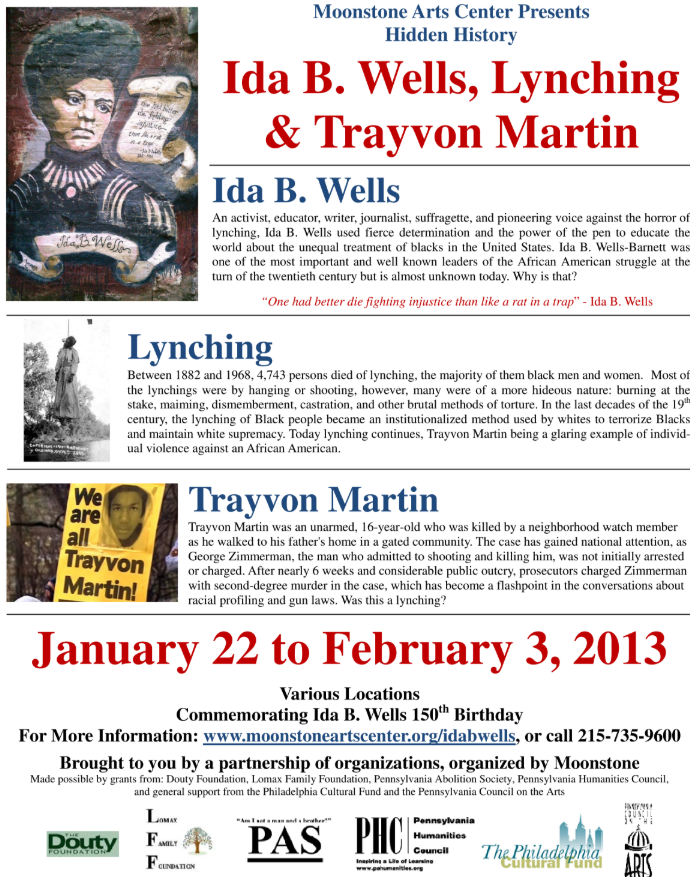
Festival Highlights
The festival lasted for 13 days, from January 22- February 3, 2013. The festival included 24 different speakers, the most speakers of any Hidden History Festival to date. The event was spread across 15 locations around Philadelphia. Notable events included A teacher’s workshop lead by Mia Bay at the African American Museum in Philadelphia, a panel discussion at Moonstone Arts Center featuring Mia Bay, Michael Coard, and Linn Washington Jr moderated by Erica Armstrong Dunbar.
Mia Bay
Michael Coard
Linn Washington Jr
Erica Armstrong Dunbar
The festival’s signature panel discussion was titled Separate but Equal?: Reasons for a Separate Black Media in the 21st Century and was held at Temple University, It featured historians and journalists, Lori L. Tharps, Kiera Mayo, Irv Randolph, Stephanie Renee, and Vernon Odom.
Lori L. Tharps
Kiera Mayo
Irv Randolph
Stephanie Renee
Vernon Odom
The festival also featured a discussion on Ida B. Wells at District 1199C Philadelphia Headquarters with John H. Bracey Jr, Paula Giddings, and Sonia Sanchez,
John H. Brancy Jr.
Paula Giddings
Sonia Sanchez
A panel discussion at Ethical Humanist Society of Philadelphia titled Slavery, Black Laws, Contract Labor, Jim Crow, Lynching, Prison/Industrial Complex, Death Penalty featuring Shujaa Gram, Pam Africa, L.V. Gaither, and Michael Coard
Shujaa Gram
Pam Africa
L.V Gaither
Michael Coard
Other events were held at the Cecil B.Moore Branch Library, First Unitarian Church of Philadelphia, Mother Bethel AME Church, Paul Robeson House, David Cohen Ogontz branch library, Joseph E. Coleman Northwest Regional Library, Walnut Street West Branch Library, Moonstone Arts Center, Kensington International Business High School, Breslin Training Center, and Lucien Crump’s Art Gallery
The Life of Wells
Ida B. Wells was born into slavery in Holly Springs Mississippi July 16, 1862, six months before the Emancipation Proclamation was passed. She grew up during Reconstruction, a time of hope and freedom. Both of her parents died of Yellow Fever in 1878, leaving her the head of her household of five younger siblings at 16 years old. To provide for her family, she left school and earned her teachers certificate before moving to Tennessee to teach.
In 1884, Ida B. Wells was forcibly removed from the ladies car of a train after refusing to sit in the segregated section. She sued the railroad and won, but 3 years later the Tennessee Supreme Court overturned her case.
In 1889, she began her professional writing career, becoming part owner of the Memphis Free Speech and Headlight. Three years later in 1892, three of her friends were lynched on the outskirts of Memphis. Her friends were arrested over a business rivalry, stolen from jail, then killed. Wells wrote an editorial in her newspaper attacking lynch mob for its barbarism. Angered, the mob attacked and destroyed the offices of the Free Speech newspaper and threatened Ida B. Wells’ life, cautioning her to never return to Memphis.
“Our country’s national crime is lynching. It is not the creature of an hour, the sudden outburst of uncontrolled fury, or the unspeakable brutality of an insane mob “
– Ida B. Wells
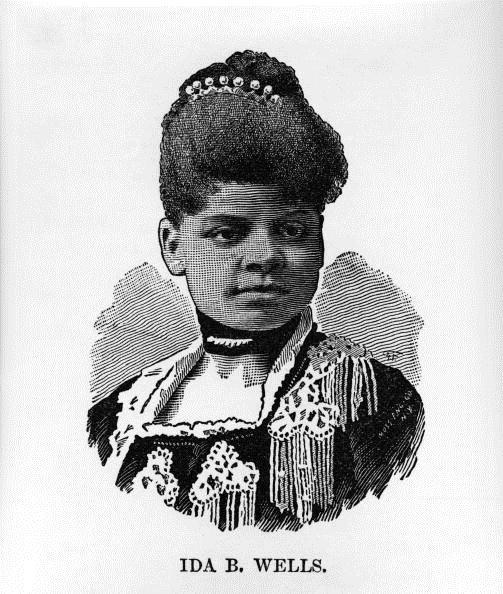
This prompted her to move to New York where she began to investigate lynchings. She published her findings in the book, Southern Horrors: Lynch Law in All its Phases. This was not her only publication, she published The Reason Why the Colored American is Not in the World’s Colombian Exposition, highlighting the expulsion of African-Americans from Chicago’s World’s Fair in 1893. Later that year she published a lynching pamphlet A Red Record.
Ida B. Wells helped found the National Association of Colored Women in 1896. She challenged police harassment in New Orleans through a story called Mob Rule in New Orleans in May of 1900. In 1909 she helped found the National Association for the Advancement of Colored People (NAACP). Ida B. Wells went on to found the Negro Fellowship League in 1910. Her reformist mindset did end there, Wells then turned her energies towards the suffrage movement, trying to secure women’s right to vote. She participated in the National American Women’s Suffrage Association’s parade in Washington on March 3, 1913. Wells spent the next two decades challenging racism and addressing the great issues of her day before she died in Chicago on March 25, 1931.
Historical Significance
Ida B. Wells harnessed the power of the pen second to none. She wrote with strength, and was bold, unforgiving, and relentless. Ida B. Wells used this gift to magnify public understanding of lynching. Her writing exposed the brutal nature and injustice brought to African Americans by the Jim Crow Laws. She was fearless, writing the stories that needed to be written, regardless of the dangers it posed to herself. Ida B. Wells also helped found multiple organizations leading the charge to generate social reform. She helped found the National Association for the Advancement of Colored People (NAACP) which is still active today.
She was one of the first investigative reporters and sociologists and studied lynching, exposing the myth of black male rape of white women as a lynching justification.. Ida B Wells’ intelligence, integrity, bravery and commitment gave her the title of “The Mother of the Civil Rights Movement,” and that makes her a role model today.