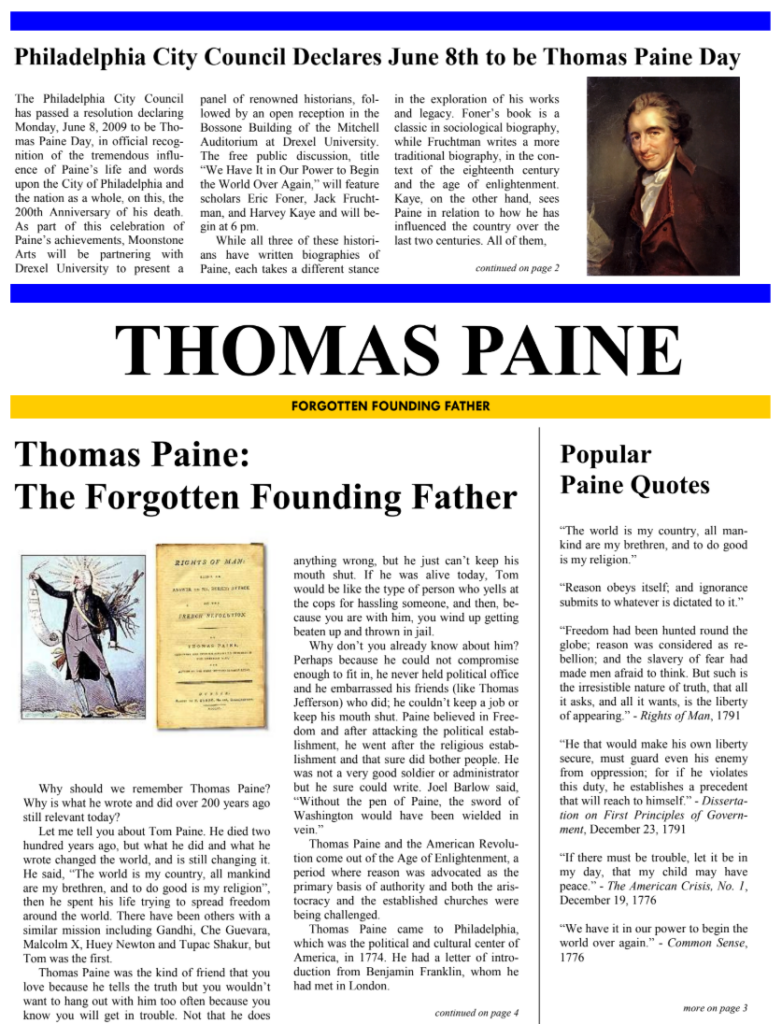
To announce the festival Moonstone released a newspaper on Thomas Paine. This included the story of Paine but also 7 finalist essays from a High school contest. Moonstone Worked with the School District of Philadelphia to host a contest that prompted students to write as Thomas Paine did. The essays included, Argument for the legalization of Gay marriage by Micheal Littlejohn, Argument against the Use of Biofuel by Marques Harvey, On the Use of Torture by Tristan Kavanaugh, The Global Gag Rule should be Nullified by Kellie-Shanygne Wint, Give Me some Room to Breath by Peilin Zhao, Where’s the Support for the Middle Class Students by Samantha Rufifn, and Give me liberty, or give me death by Torri A. Yeargins and Rebecca Nathan.
Festival Highlights
Moonstone’s festival surrounding Thomas Paine was centered around a panel discussion featuring Eric Foner, Jack Fruchtman Jr, and Harvey J. Kaye at Drexel University. The discussion titled “We Have it in Our Power to Begin the World Over Again” was about the life and influence of Thomas Paine. Events were hosted at local Philadelphia high schools, the Historical Society of Philadelphia, and the Free Library of Philadelphia before capping off with the Panel Discussion at Drexel University on June 8th, 200 years after Paine’s Death.
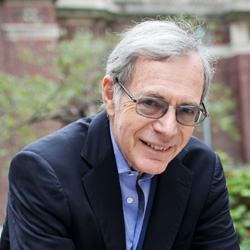
Eric Fonner
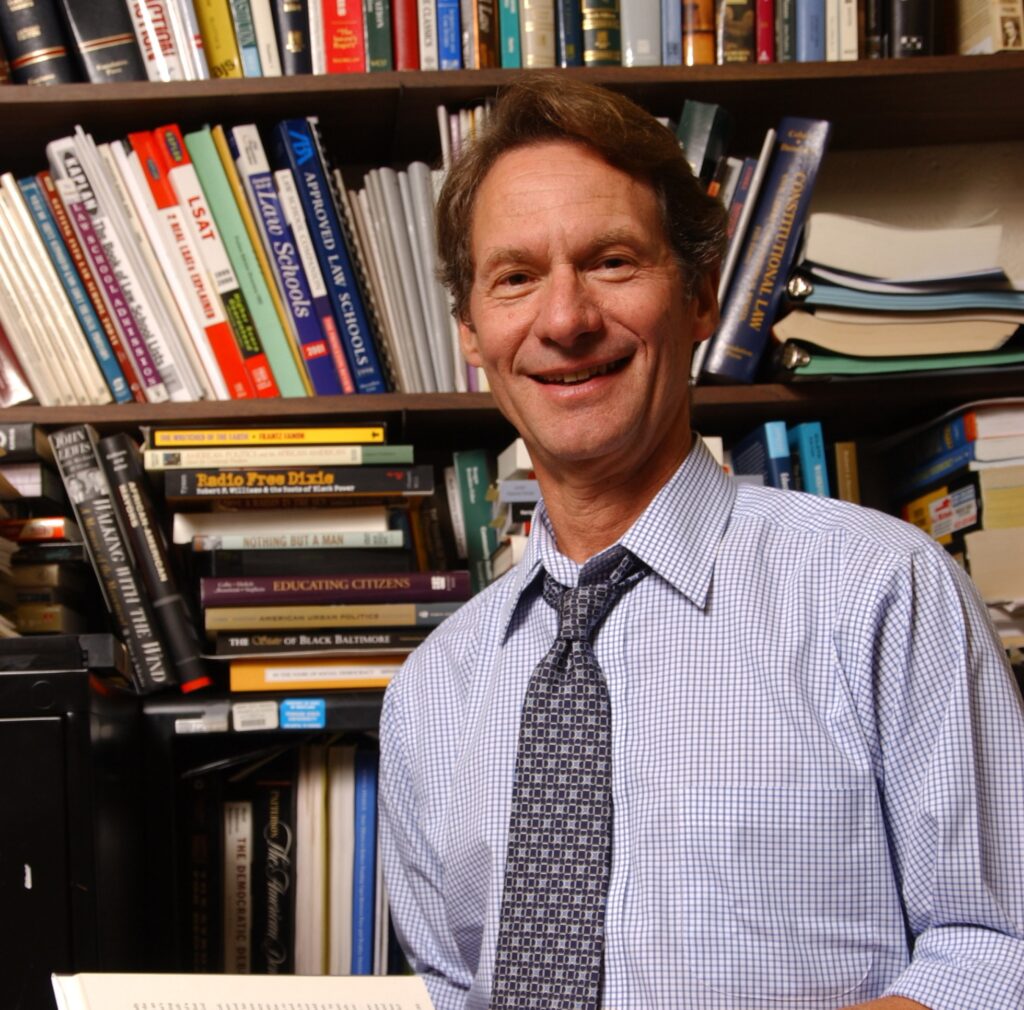
Jack Fruchtman Jr
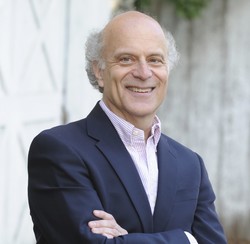
Harvey J.Kaye
To announce the festival Moonstone released a newspaper on Thomas Paine. This included the story of Paine but also 7 finalist essays from a High school contest. Moonstone Worked with the School District of Philadelphia to host a contest that prompted students to write as Thomas Paine did. The essays included, Argument for the legalization of Gay marriage by Micheal Littlejohn, Argument against the Use of Biofuel by Marques Harvey, On the Use of Torture by Tristan Kavanaugh, The Global Gag Rule should be Nullified by Kellie-Shanygne Wint, Give Me some Room to Breath by Peilin Zhao, Where’s the Support for the Middle Class Students by Samantha Rufifn, and Give me liberty, or give me death by Torri A. Yeargins and Rebecca Nathan.
Festival Impact
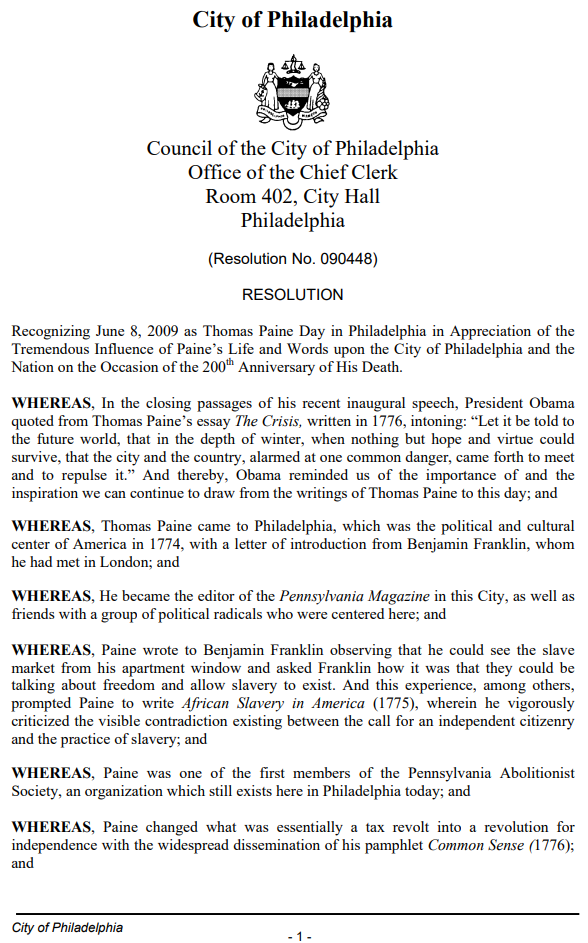
The Thomas Paine Festival had lasting impacts in the Philadelphia area. 13 days after the Drexel panel discussion the city council of Philadelphia passed Resolution 090448 making June 8th Thomas Paine Day. The success of this festival led to the hidden history project becoming a series, leading to 8 years of festivals and programming in the Philadelphia area.
The Life of Paine
Thomas Paine was born in England on February 9, 1737. Later in life in England he met Benjamin Franklin who wrote him a letter of recommendation to work at the Pennsylvania magazine in Philadelphia in 1774. Philadelphia was the center for activism in the colonies during this time. In1775 Paine wrote Common Sense, a pamphlet that promoted the ideas of freedom and denounced the British monarchy.
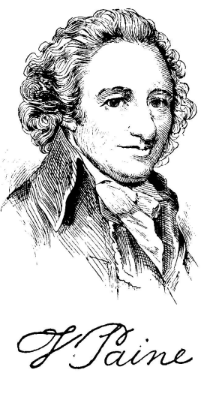
When the American revolution began to stall out after the first few months of the war, Paine wrote the first edition ofThe Crisis which convinced scattered and disorganized troops to continue the struggle. The Crisis was frequently read before battles to inspire the revolutionary soldiers.
Eventually Paine returned to Great Britain in 1787 where he published writings defending the French Revolution. This put him on the radar of the British Monarchy who were trying to suppress radical political philosophy at the time. They were afraid the French revolution could spread. The Monarchy put out a warrant for Paine’s arrest and he narrowly escaped to France in 1792. Paine returned to America where he resided in New York until he died on June 8, 1809.
Historical Significance
Paine was the catalyst that ignited the American revolution; his pamphlet Common Sense was a tipping point for the revolutionary cause, turning a tax revolt into a full blown political revolution. Common Sense reached the common people writing in a language they could understand. The pamphlet spread the idea that “We the people” have the power to govern and have the ability to participate in politics. This empowered the colonists in a way never seen before. As the reality of war set in for the revolutionaries, Paine wrote The Crisis which encouraged the colonists to continue fighting. All of the proceeds made by Common Sense and The Crisis were given to Washington to help fund the Army. Without the pen of Paine Washington’s efforts in the battlefield could have been fruitless.
It is through Paine’s eloquent writing on the nature of freedom, equality and liberty that the revolutionary cause was given life. Paine’s legacy speaks to the power of writing to change society.