The 7th edition of The Hidden History program was a little different from its previous additions. Hidden History-Voices of Women focused on extraordinary women who worked to make America live up to the promise of Life, Liberty, and the Pursuit of Happiness regardless of race, class, gender, ethnicity, religion, age, or sexual orientation. The program was not centered around a central individual but rather celebrated the centrality of women in creating social reform.

Festival Highlights
The festival lasted for 27 days, from October 13-November 9, 2013. This was the longest festival to date. It featured 23 events across 13 different venues in the Philadelphia area. The festival kicked off with tours of the Historic Fair Hill Burial Ground, a 300 year old burial site and the final resting place of Lucretia & James Mott. Other notable events include Lucretia Mott: The Greatest American Women a panel discussion at the Historical Society of Pennsylvania featuring historians and authors: Christopher Densmore, Carol Faulkner, and Beverly Wilson Palmer,
Christopher Densmore
Carol Faulkner
Beverly Wilson Palmer
Voices of Women: Today & Tomorrow a Discussion with Nina Ball, Denise Brown, Sonia Sanchez, and Amy Scholder
Nina Ball
Denise Brown
Sonia Sanchez
Amy Scholder
Women in Journalism a discussion with Linda Foley, Megan Marshall, and Mary Walton at the Brandywine Workshop.
Linda Foley
Megan Marshall
Mary Walton
Other notable events include:
Ode To Margret Fuller a talk by Rev. Michael Barnett at the Brandywine workshop, Fanny Jackson Coppin a talk by Dr. Beatrice Johnson at the Marion Anderson Center, Harriet Jacobs Freedom Narrative a discussion with Jean Fagan Yellin & Fara Jasmine Griffin at the Independence Seaport Museum, Women and the Civil War a discussion between Judith Giesburg and Stephanie McCurry at University of Pennsylvania Museum of Archeology & Anthropology, and Barbra Gittings a talk by Sherrie Cohen at William Way LGBT Community Center.
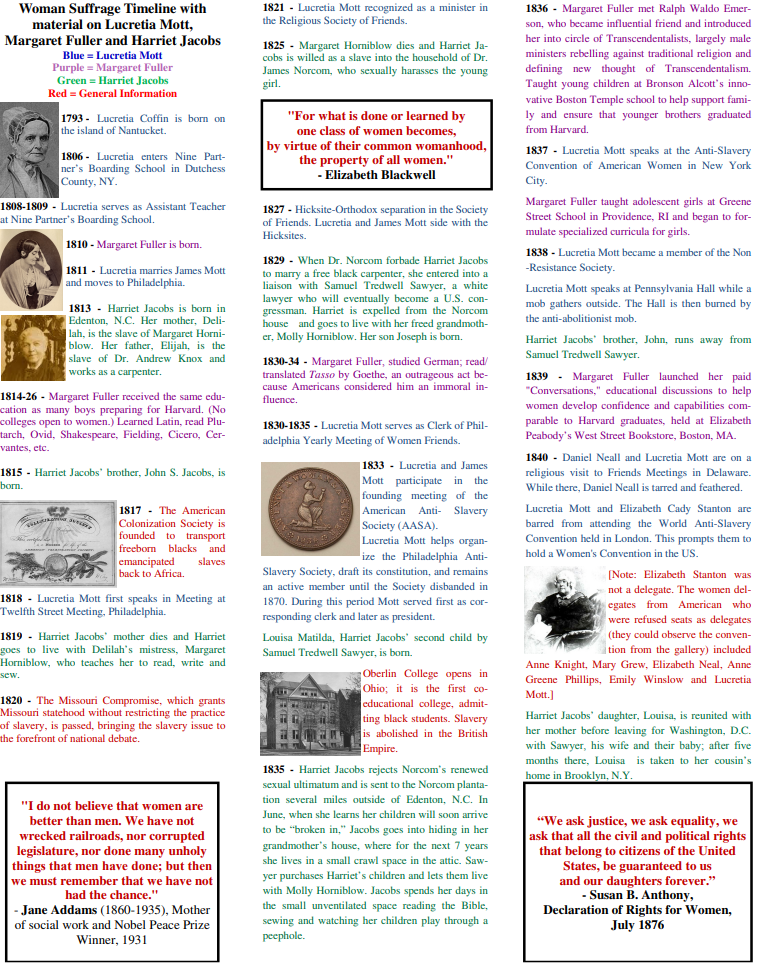
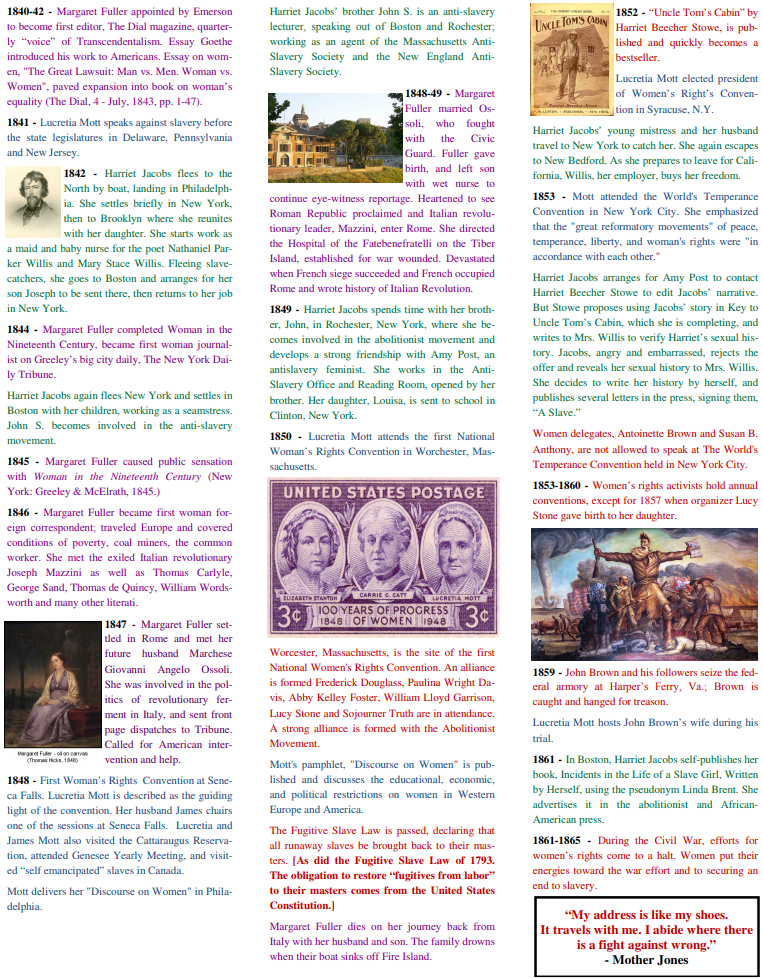
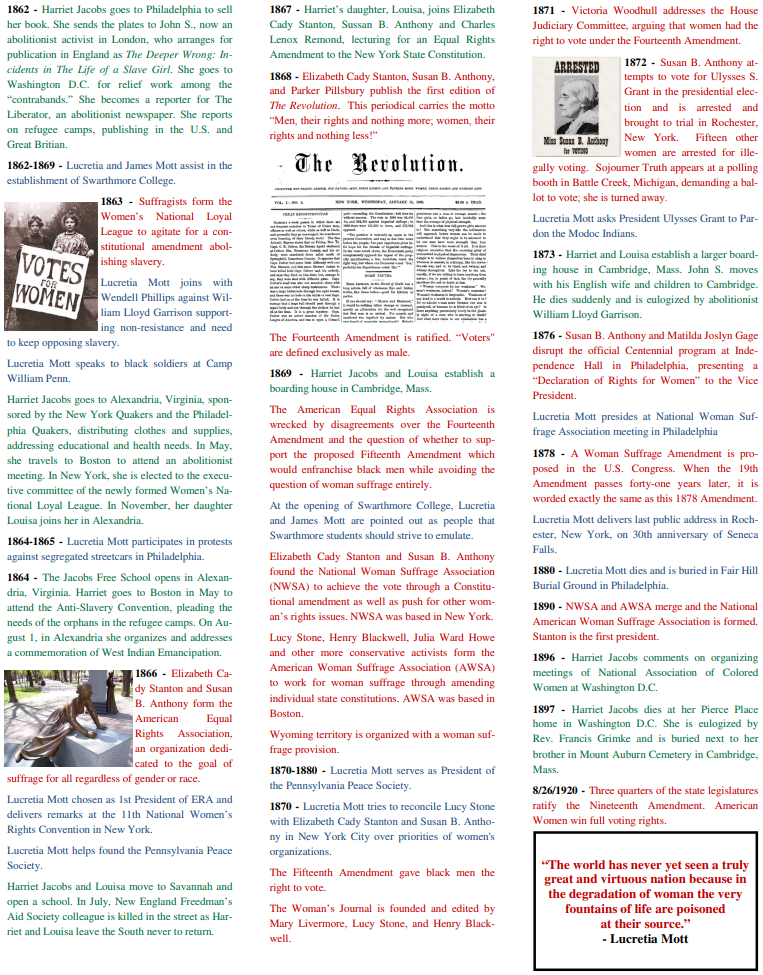
More events were held at the Alice Paul institute, First Unitarian Church of Philadelphia, National Museum of American Jewish History, and Mother Bethel AME Church. The Newspaper released for Voices of Women, included an itinerary for the festival and a detailed timeline highlighting the Women’s Suffrage movement through material on Lucretia Mott, Margaret Fuller, and Harriet Jacobs
Three Extraordinary Women
LUCRETIA COFFIN MOTT:(1793-1880) devoted her life to the abolition of slavery, women’s rights, school and prison reforms, temperance, peace, and religious tolerance. “It seemed to me like meeting a being from some larger planet to find a woman who dared to question the opinions of popes, kings, senates, parliaments, recognizing no higher authority than the judgment of a pure-minded, educated woman. When I first heard from the lips of Lucretia Mott that I had the same right to think for myself that Luther, Calvin and John Knox had, and the same right to be guided by my own convictions and would no doubt live a higher, happier life than if guided by theirs, I felt at once a newborn sense of dignity and freedom. It was like suddenly coming into the rays of the noonday sun after wandering with a rush light in the caves of the earth.” Eighty Years And More: Reminiscences 1815-1897 by Elizabeth Cady Stanton
MARGARET FULLER: (1810-1850) America’s first true feminist, Margaret Fuller holds a distinctive place in the cultural life of the American Renaissance. Transcendentalist, literary critic, editor, journalist, teacher, and political activist, ultimately turned revolutionary, she numbered among her close friends the intellectual prime movers of the day: Emerson, Thoreau, the Peabody sisters, the Alcotts, Horace Greeley, Carlyle, and Mazzini–all of whom regarded her with admiration and sometimes even awe.
HARRIET ANN JACOBS: (1813 –1897) was an African-American writer who escaped from slavery and became an abolitionist speaker and reformer. Jacobs’ single work, Incidents in the Life of a Slave Girl, published in 1861 under the pseudonym Linda Brent, was one of the first autobiographical narratives about the struggle for freedom by female slaves and an account of the sexual harassment and abuse they endured.